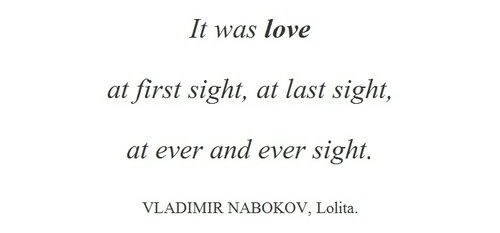
Lolita by Vladimir Nabokov

a51668c2d331d0924c1212baa2bd4eb0For awhile I’ve had a “list” in my mind of classic books that I’ve wanted to read. These are books that have stood the test of time and that people continue to talk about today. A big one on my list was Lolita by Vladimir Nabokov. I feel like this book and story have remained relevant over the years and that people even still make reference to it in pop culture. I will admit, I didn’t really know what to expect from the novel. I had seen bits and pieces of the movie when I was younger, but I don’t think I really understood what was happening. I was also aware that people had described it as being pornographic or an “erotic novel” so I wasn’t really sure what I was getting myself into when I started reading it.

First of all, I want to say that I loved how poetic and descriptive it was. At times, it was hard to get through all of the descriptions and tangents that the narrator would go off on, but it was so beautifully written that it didn’t really feel like I was putting that much effort into reading it. However, there was a lot about the story that made me uncomfortable, and sort of took away from me actually really liking this book (which I’m about to get into), but as a whole I can appreciate the story and the writing.

I feel like a lot of my feelings toward this book could come from being a woman who grew up/is growing up in a time when we talk a lot about consent. The whole time I was reading this, I couldn’t help but to try to see the events occurring from Lolita’s point of view and trying to find something that would make me feel like he wasn’t raping her every time they would have a sexual encounter.

That being said, I didn’t really like the whole destruction of innocence theme. I know that’s pretty much what the whole book is about and that the narrator is aware that he is doing this to her, but I don’t feel like he’s even taking into account how she really feels or how this is affecting her. He treated her like she was something he owned, like his own personal sexual object and that kind of makes me cringe.

In my opinion, he was an abuser. I know that at times it seemed like she had seduced him and that maybe she was using him to get things that she wanted, but I also felt like she may not have known what would happen to her if she stopped giving him sexual favors and appealing to his wants and needs. He constantly told her about how good her life was with him and how lucky she was to travel and have all these nice things, and that if she were to go live with someone else she would lose all of her personal belongings. He wouldn’t let her go out with friends if boys were going to be there or enjoy herself as a child/teenager and do normal things that kids do because of his jealousy. In order to do those things and have her way, she would have to give him something in return. He completely manipulated her in every way to get what he wanted out of her, and it kind of made me sick. It was pretty hard to read his thoughts and how obsessed and jealous he would get.

I also felt like the married “adult” version of Lolita would not have greeted him so warmly and go as far as to call him a good father. Perhaps this is part of the narrator being unreliable and trying to make it seem like what he did to her didn’t have that much of an effect on her after all. In my opinion, this interaction between them could have just been Lolita trying to make him happy again so that she would get what she wanted (money) out of him.

I would say that this is definitely not as pornographic as people make it out to be (Thankully, because I don’t know if I would have finished it if that was the case). A lot of the story was about traveling with her and trying to keep her to himself, there were hardly any descriptions of the more explicit content in comparison. It definitely does have these elements and reeks of pedophilia, which made it hard for me to read and fully enjoy and appreciate. I also still don’t really feel like I found anything about the narrator that redeemed his actions. He just seemed like someone who took what he wanted and didn’t really care about how others would be affected by his actions. I do not believe that he really loved her, but rather that he loved the idea of having his own little nymphet.
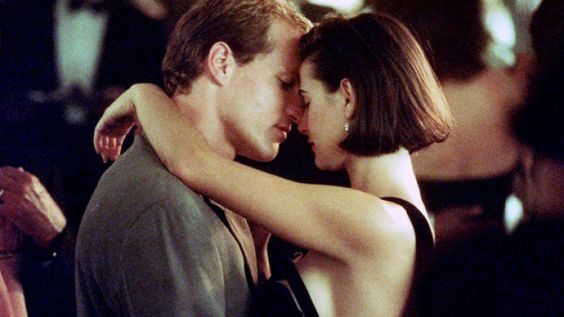
Indecent Proposal by Jack Engelhard

dc30b5b3e3bd9143df545554097781bf

So apparently the only reason I read books now is if I really like the movie they’re based on. Just kidding, but the following review definitely continues the trend of my past few reviews.

I absolutely loved the move Indecent Proposal the first time I watched it. My mom told me that she thought I would like it, and it happened to be on Netflix so I gave it a shot. Demi Moore is absolutely beautiful and I loved her with Woody Harrelson. I thought that they were believable as a couple and genuinely seemed to have chemistry in the film. Spoiler alert for those who haven’t seen the film/read the book, the whole plot of having a rich man offer money to a poorer man for one night with his wife was crazy. The movie was exciting, it made me angry, it made me cry, and it made me believe that maybe true love and true soulmates do exist.

I was so excited to read this book because I love all the extra little details that usually get cut when a novel is adapted into film. However, I soon found out that the film is really just loosely based on the novel and that the characters are not the same at all.

Other than the “rich man pays poorer man for one night with his wife” theme and meeting in the casino, the stories were pretty different. The movie was definitely much simpler and didn’t include any sort of racial differences in characters like the novel. I think that a lot of what motivated/pushed the characters in the story had to do with their racial/religious/personal backgrounds and we didn’t see any of that in the movie.

All that said, I do kind of like when books are different from their film adaptations because it keeps things interesting. I definitely think that I liked the movie more still, it was more entertaining and I liked that it showed the wife’s point of view as well. I also thought that some of the main parts of the book were unrealistic and that kind of turned me off from the book. For instance, when Joshua visits Ibrahim and is shown the “sex tape” he secretly filmed and then they get into a physical altercation. I just couldn’t see this whole situation actually playing out the way it did in real life.

There’s really a lot more that I could say about this book, but I feel like this is getting pretty long already so I’ll cut it short. Overall, I liked that the novel can stand on its own and that it isn’t exactly the same as the story in the film. I liked that at the end I still felt like the two were meant to be together, and I liked that the story really makes you think about the proposed situation and what it would be like that have that sort of offer on the table. It’s definitely an interesting idea and I would definitely recommend the book to any one who has seen the movie or is just interested in the plot.

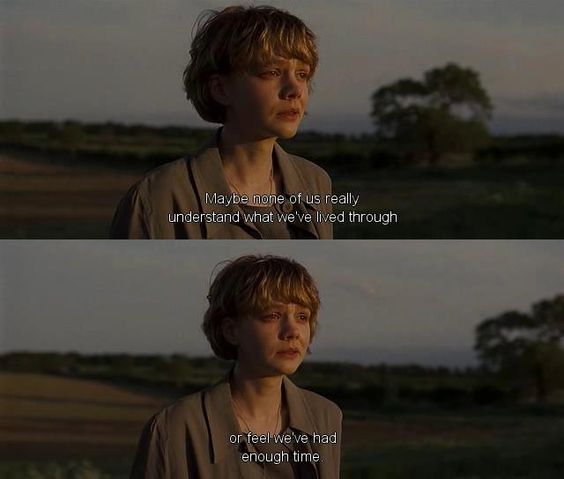
Never Let Me Go by Kazuo Ishiguro

16e33251b32345e342f9f46a04ba4c6a

So, a little while ago I finished a novel called Never Let Me Go. There’s so much that can be said about this story that I’m not even sure where to begin.

First of all, I have to say that I absolutely loved this book. I actually saw the film version first and loved it, so I (of course) had to read the book and I was not disappointed.

The story is about a girl name Kathy who is reflecting on her time as a student at a boarding school-type place called Hailsham, and on the direction that her life went after she left school. Hailsham is different from other schools because its students are clones who will grow up and donate their organs when they come of age.

As children, it seems that the clones weren’t fully aware of their fate but did know that they would be making these “donations” as adults. The idea of having these clones that are raised and harvested for their organs is definitely something that was interesting throughout this story. I think that this “idea” is something that has probably been considered in real life, especially with stem cell research and its important to have stories like this to really think about what life would be like for these people if that actually happened.

What really makes this story interesting are the relationships that Kathy has with other clones, especially Tommy and Ruth. Kathy has romantic feelings for Tommy but can’t act on them because her friend Ruth has already made Tommy her boyfriend. Throughout the story, Tommy and Kathy are very obviously attracted to each other and want to be together. However, Ruth interferes with their relationship every chance she can get. When they are older and Ruth has begun making her donations, Kathy begins taking care of her and Ruth reveals to her that she wants Kathy to pursue a relationship with Tommy and that she regrets keeping them apart for so long.

By this time, Tommy has also already begun his donations. Seeing Kathy and Tommy try to stop or delay the process of donations for themselves so that they can be happy for just a few more years is really heartbreaking. You want to root for them so badly, but it seems that nothing can go right for the couple.

This story is really so, so good. I could definitely go on for awhile talking about every thing that I loved about this book, but really I don’t want to spoil it all because I think people should read it for themselves.

I would love to hear from others who have read this book and to find someone to discuss it with further because there really is SO much to talk about. Leave me a comment! And thanks for reading!

Dr. Lisa Kay Receives the Mary J. Rouse Award

unnamed_0View original post at http://tyler.temple.edu/blog/dr-lisa-kay-receives-mary-j-rouse-award

Dr. Lisa Kay, an assistant professor in the Department of Art Education and Community Arts Practices, has been honored with the Mary J. Rouse Award.

“Seeing my name added to the list of the previous award recipients, who have shaped the field of Art Education, is an incredible tribute,” Dr. Kay said. “I am humbled.”

The award is given by the National Art Education Association Women’s Caucus. Its purpose is to recognize the work of a professional who has shown potential to make significant contributions in the art education profession.
Continue reading

Emerge 2014 Academic Award Goes to Kate Clements

Clements_image1_Untitled(Wall)-1View original post at http://tyler.temple.edu/blog/emerge-2014-academic-award-goes-kate-clements

Emerge 2014 attracted more than 320 entrants from artists in 32 countries and 35 universities. 42 of the artists were selected to win awards.

MFA Glass student Kate Clements received the Emerge 2014 Academic Award for her piece Untitled (Wall). It was her second time submitting work.

“While I was in undergrad at the Kansas City Art Institute I got into Emerge 2010 but wasn’t an award winner,” Clements said. “The push for me to apply this year came from Sharyn O’Mara and the glass department’s artist in residence Dan Clayman, they were both excited and confident that the piece would do well in the show and that I should make time to apply even though it was at the end of the semester. I almost didn’t apply!”
Continue reading

Ceramics Senior Kat Lee Awarded Windgate Fellowship

KatLee-58View original post at http://tyler.temple.edu/blog/ceramics-senior-kat-lee-awarded-windgate-fellowship

Each year, the Windgate Fellowship program receives two nominations from more than 50 colleges and universities across the United States. Out of these 100 nominations, 10 graduating seniors working in a craft medium or process are awarded $15,000.

Kat Lee, a graduating senior in ceramics, was one of the few students to receive the award.

“Nick Kripal, the head of my department, had asked if I would like to represent one of the two positions,” Lee said. “I agreed knowing it was a great opportunity just being selected as one of the two students from Tyler. I was also aware of a past ceramics major that received the Windgate award and decided to give it a shot. There was nothing to lose.”
Continue reading

Casinos: History of Gambling in Philadelphia

timthumb.phpView original post at PhiladelphiaNeighborhoods.com

It may seem like it is taking a while for the Pennsylvania Gaming Control Board (PGCB) to issue Philadelphia’s second gaming license, but the wait is nothing that the city has not been through before. The process for legalized gambling in Pennsylvania goes all the way back to the late seventies when Atlantic City opened up their first hotel casino.
Continue reading